
Every employer has typed “free job posting in India” into Google at some point, usually while trying to fill a role without blowing the recruitment budget. But here’s the catch: not every free platform works the same way. Some let you post unlimited jobs but hide resumes behind a paywall. Others give you full candidate access but cap how many jobs you can list per month. Picking the wrong one for the wrong hire wastes time you don’t have.
In this guide, you’ll learn which platform suits different hiring needs, where free plans typically stop being “free,” how to get the most out of free hiring tools, the mistakes most employers make when posting jobs, and what to do if free hiring isn’t cutting it anymore. Understanding what today’s job seekers want including the rise of high-paying roles that don’t require a degree also helps you frame listings that pull in the right applicants.
Employers in India can post free job listings without having to pay anything upfront. However, in most cases, employers will find that there is not complete freedom, because resume access, candidate communication, visibility, or hiring assistance usually has some limits.
Why Free Job Posting Matters for Employers
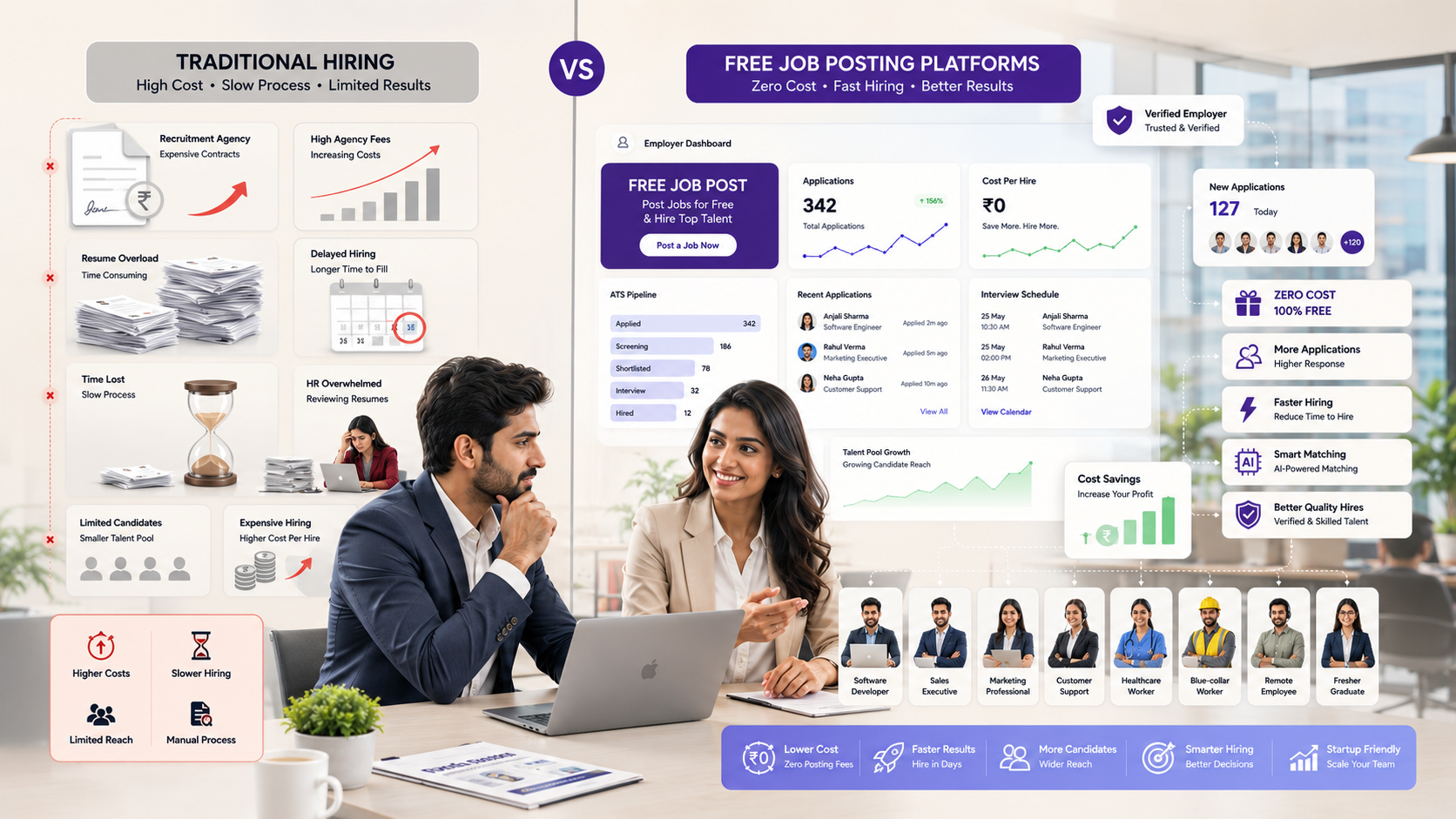
One bad hire can take months to onboard, and conventional recruiting firms take their cut in terms of a percentage of the recruit’s salary to merely generate a shortlist.
Recruitment expenses in India really rack up when one accounts for agency charges, membership of high-end job portals, and the amount of time wasted internally going through resumes.
For a startup running lean, that’s budget better spent on product or payroll. Comparing the top job portals in India side by side helps you understand where hiring demand concentrates and which platforms give free listings the most reach across different sectors.
There is a clear difference between startup recruitment problems and enterprise-level recruitment. Startups typically face the challenge of recruiting at a very fast pace, with less known employer branding, and without having their own HR department. Free platforms provide startups a chance to attract candidates without having large budgets.
Large-scale hiring also has its peculiarities. While one company recruits 50 people per quarter in volume, the other company does it twice per year in precise ways. Free platforms serve both of them, but approaches vary.
Some of the advantages of using free recruitment platforms include decreased cost per hire, fast posting times, and a wide array of job seekers.
What Does Free Really Mean on Job Posting Platforms
This is where most employers get caught off guard. “Free job posting” and “free hiring” are not the same thing.
Free posting versus free hiring: While posting the job for free is allowed on most sites, free hiring, which includes looking at profiles, communicating with candidates, and managing the applications, may not be.
Some of the hidden limitations that you should look out for include:
- Resume viewing: Most sites allow you to post your job listing for free but require a paid upgrade before you can see full candidate profiles.
- Message restrictions: Most sites have limits on the number of candidates you can message for each job per day within a free plan.
- Posting visibility: Your job listing might appear below paid posts, limiting the number of candidates who will see it.
- Paid perks: These include priority placement, a branded company page, and bulk resume downloads.
This knowledge helps in using a free recruitment site efficiently rather than considering it a full-fledged hiring site.
Which Free Job Posting Platform Is Best for Different Hiring Needs
It all depends on the position you are looking to fill, the scale of your hiring process, the industry, and the skill level, rather than the number of free services offered by the website.
Hiring Freshers: You should choose sites that have a high pool of freshers and students, since fresher hiring is more about the number than filtering. It also helps to understand why so many entry-level jobs still ask for experience, so you can set realistic expectations in your listing and avoid scaring off first-time applicants. Government-focused platforms listing state and UPPSC government job openings are another strong source of fresher-friendly roles across India.
Hiring Experienced Professionals: Then you should choose a site that provides a decent resume search facility.
Remote Employee Recruitment: Find sites that enable candidates to sort according to “remote,” and also have a candidate pool that is geographically dispersed rather than localized to a single city.
Blue Collar Worker Hiring: This profile would be best suited for those platforms where regional language capability is strong, and the application process is more mobile-first.
Part-Time Employment Recruitment: Those platforms that appeal to gig workers and students produce quicker applications for part-time positions than do generic job portals.
Intern Recruitment: Same considerations as for freshers recruitment but with internship being a separate category on the platform because otherwise it will be difficult to find among generic listings.
IT Professional Recruitment: You need skill tagging and resume parsing capability in the platform to avoid having to filter through thousands of applications yourself. If you’re hiring in a specific tech hub, it helps to know the local market for example, the demand for IT jobs in Bhopal, or the top IT companies hiring in Bhubaneswar, so you can pitch your role against what candidates are already comparing it to.
Sales Team Recruitment: Sales professionals are more responsive to platforms offering performance-based or incentive-based job descriptions.
Healthcare Staff Recruitment: Specialized job boards or specialized platforms will do better than generic job portal websites in India. Being aware of prevailing healthcare job salaries in India also helps you post competitive pay bands that attract qualified medical talent.
How to Choose the Right Job Posting Platform
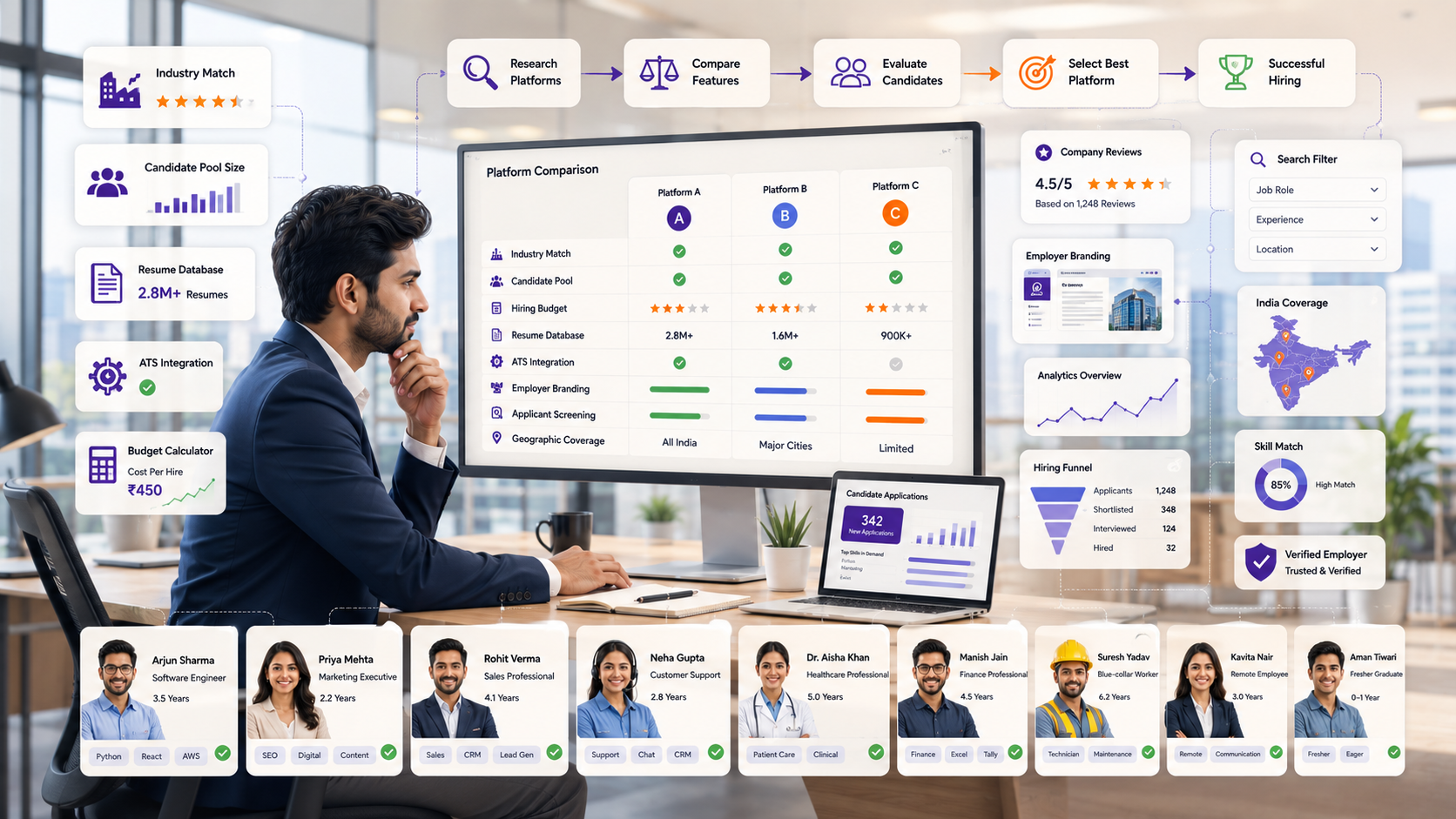
Before finalizing a platform, consider this checklist:
- Industry: Do they have an active candidate pool in your industry?
- Candidate pool: Is there sufficient availability of the skill set you are hiring for?
- Hiring budget: Will you be able to stay on the free plan, or do you have to move up to the paid plan for this particular role?
- Resume database: Is their resume database searchable or limited to inbound applications only?
- ATS integration: Is the platform compatible with your ATS?
- Employer branding: Can you create a company page, gather reviews, and highlight your culture through the platform?
- Applicant screening: Are the applicants prescreened, or can it be an open posting with no screening involved?
- Geographical location: Do they provide coverage in the cities or locations where you want to hire?
Free vs Paid Job Posting: What Is the Difference?
| Feature | Free Job Posting | Paid Job Posting |
| Job Posting | ✓ | ✓ |
| Resume Access | Limited | Full |
| Candidate Messaging | Limited | Unlimited |
| Employer Branding | Basic | Advanced |
| Job Visibility | Limited | High |
| Hiring Speed | Moderate | Faster |
If you’re comparing free vs paid recruitment, the honest answer is that free works well for high-volume, less specialized roles, while a paid hiring platform or recruitment software subscription pays off when you’re hiring for niche or senior roles where speed and candidate quality matter more than saving on cost.
What Features Should Employers Look for in a Free Job Portal
Even within free plans, some platforms offer meaningfully more than others. Look for:
- Resume search
- ATS compatibility
- Employer dashboard
- Candidate filters
- Mobile app
- Applicant tracking
- Analytics (views, applications, drop-off rates)
- Employer profile page
- Verification badges for trust and credibility
How to Write a Job Post That Attracts More Applicants
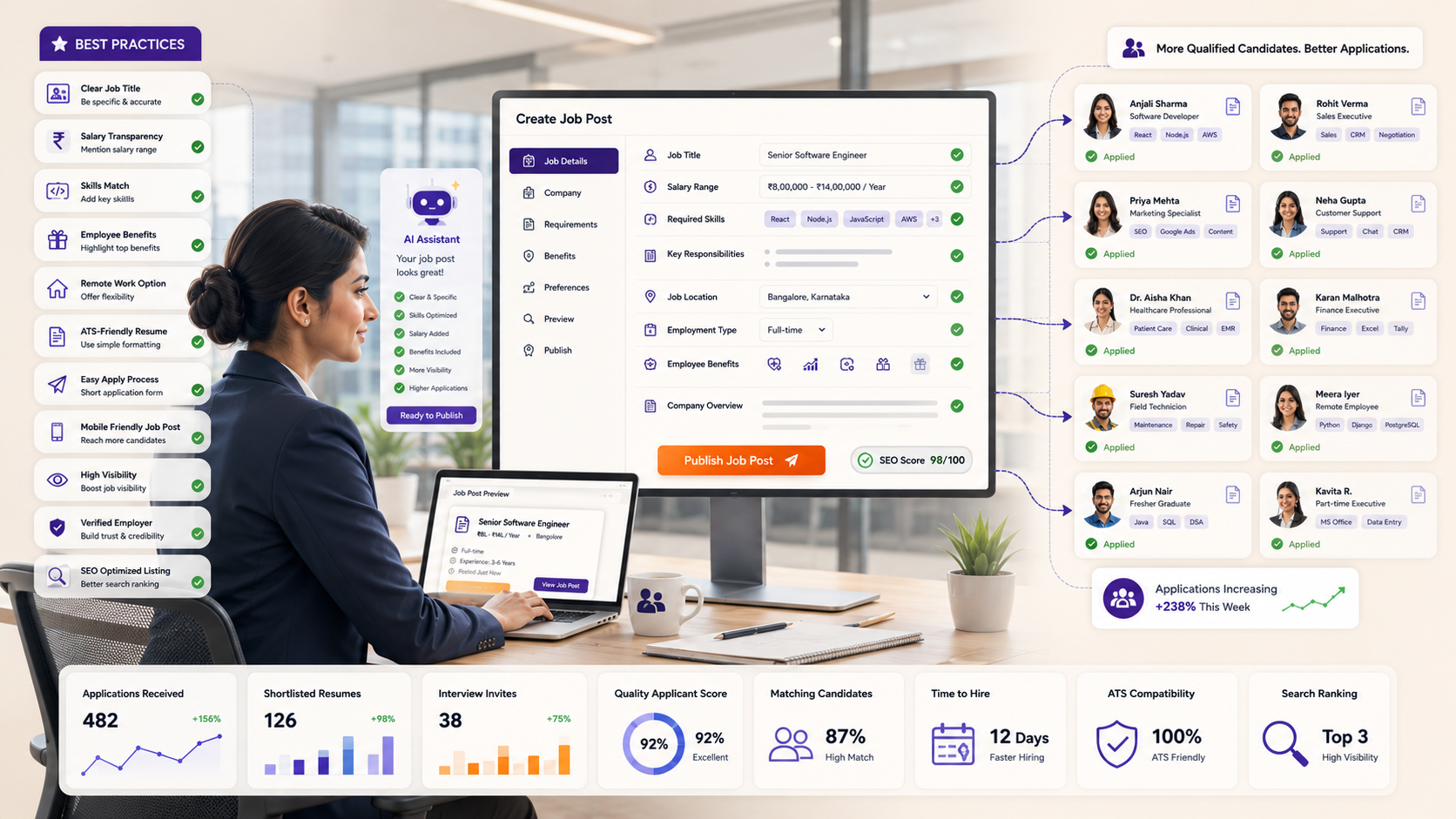
Featured Snippet Answer: The elements of an effective job listing include title, salary, skills, benefits, responsibilities, location, employment type, a brief description of the company, and a call to action.
Title: Keep it generic and searchable (“Sales Executive” rather than “Sales Ninja”).
Salary: This alone gives credibility and filters the unfit applicants at the start.
Skills: Only put down the necessary skills, not the dream skills.
Benefits: Health care coverage, remote work options, and budget for training are all examples of benefits that make you stand out from other companies.
Responsibilities: Explain clearly what the job will entail day by day.
Location: Specify whether it is remote, hybrid, or an actual office location.
Employment type: Full-time, part-time, contractual, or internship.
Company description: Two or three sentences about your company’s mission and what it is all about.
Call to action: How and where to apply for the position. Encouraging candidates to submit ATS-friendly resumes here also improves the quality of applications you can actually parse and shortlist.
Why Free Job Posts Stop Getting Applicants
If your free listing had candidates respond during week one, and nothing else after that, then several reasons apply:
- Loss of visibility: Free listings tend to lose their rankings as new postings overshadow them.
- Unattractive description of job: Vague job titles and missing key information lead to scrolling.
- Inaccurate use of keywords: If your posting doesn’t include relevant keywords, you won’t be found by candidates.
- No salary: Listings with no salary information receive fewer candidates than those that do.
- Generic job title: Titles like “manager” and “executive” don’t provide enough information for the candidates.
- The competition: Among hundreds of posts, there’s nothing special about yours.
- Behavior of candidates: Candidates now quickly filter and skim information on job listings.
When you wonder why you’re receiving no candidates at all, changing the platform isn’t even an option yet. You need to rewrite the job listing first.
Common Mistakes Employers Make While Posting Jobs
- Posting everywhere without a clear strategy
- Using confusing or overly creative job titles
- Ignoring salary transparency
- Missing key required skills in the description
- Not refreshing listings regularly
- Skipping screening questions
- Weak or missing employer branding
How to Get More Applications Without Paying
- Share the listing on social media (LinkedIn, Facebook groups, Twitter/X)
- Ask for employee referrals, often the fastest and highest-quality source
- List on Google for Jobs by structuring your listing correctly
- Post directly on your company’s careers page
- Share in local community groups relevant to the role
- Post in professional groups on LinkedIn or industry forums
- Reach out to university placement cells for fresher and intern roles
- Share in relevant WhatsApp communities and alumni groups
Hidden Costs of Free Job Posting
“Free” doesn’t mean cost-free. It just shifts the cost from money to time.
- Time: Manually screening a flood of unfiltered applications takes hours.
- Manual screening: Without ATS filters, every resume needs a human read.
- Resume quality: Free platforms attract a wider range of applicant quality, not all of it relevant.
- Candidate drop-off: Slower response times on free tiers often mean candidates accept offers elsewhere first.
- Multiple dashboards: Managing job posts across several free platforms adds administrative overhead.
- Duplicate applications: The same candidates may apply through multiple channels, creating extra cleanup work.
Best Practices for Small Businesses Hiring on a Budget
- Prioritize quality over quantity: one well-written post beats five rushed ones
- Use multiple channels together rather than relying on a single platform
- Refresh listings every few days to avoid visibility decay
- Optimize job descriptions with the keywords candidates actually search
- Build employer branding even on a budget, since a strong company profile page goes a long way
- Track application sources so you know which channels are actually working
Small businesses hiring in emerging metros can also benefit from location-specific guides for instance, how candidates go about finding the best jobs in Bhubaneswar which reveals what applicants in that market expect from listings.
Recruitment Trends Employers Should Know
Hiring in India is shifting fast, and a few trends are worth watching heading into 2026:
- AI-assisted hiring: Resume screening and candidate matching are increasingly automated, even on free platforms.
- Skills-based hiring: More employers are hiring for demonstrated skills over degrees or years of experience alone.
- Remote recruitment: Location is becoming less of a filter, opening up wider candidate pools.
- Mobile-first applications: A growing share of candidates apply entirely from their phones, especially for blue-collar and entry-level roles.
- Faster hiring cycles: Candidates expect quicker responses, and slow employers lose good applicants to faster ones.
- Employer branding importance: Company reputation on job platforms increasingly influences application rates, not just the job description itself.
It’s also worth watching the candidate side of the market. The rise of silent layoffs, where employees are quietly forced to quit, is pushing more experienced professionals back into the job market which can work in an employer’s favour when sourcing talent on free platforms.
Frequently Asked Questions
Can I post jobs online for free in India? Yes, most major job platforms in India let you post jobs at no cost, though features like resume access and candidate messaging are often limited on free plans.
Which free job portal is best for employers? It depends on your hiring need. Platforms strong for fresher hiring aren’t always the best for senior or niche technical roles, so the “best” platform changes based on the role.
How many jobs can I post for free? This varies by platform. Some allow unlimited free postings, while others cap the number of active listings per month.
Is free job posting enough for hiring? For high-volume or entry-level roles, often yes. For senior, niche, or urgent hires, a paid plan or additional sourcing usually speeds things up.
How can I get more job applications? Write clearer job titles, include a salary range, refresh your listing regularly, and share it across multiple channels instead of relying on one platform.
Which platform is best for startup hiring? Startups generally do well with platforms that offer strong visibility on free plans and don’t require a large upfront commitment.
How long do free job postings stay active? Most platforms keep free listings active for 15 to 30 days before they expire or need to be renewed.
Are free recruitment websites safe? Established, well-known platforms are generally safe, but employers should still verify candidate details independently and avoid platforms with no verification process.
Can I hire remote employees for free? Yes, many free job posting platforms allow you to specify remote roles and reach candidates outside your immediate city.
How do I choose the right recruitment platform? Match the platform to your hiring need. Consider industry fit, candidate availability, budget, resume access, and geographic reach before committing.
Where to Start
Start by identifying the role you’re hiring for, then select a platform based on the type of candidate you need rather than which one is simply free. From there, optimize your job description, combine a few free channels instead of relying on just one, and track where your applications are actually coming from so you can double down on what works.
