
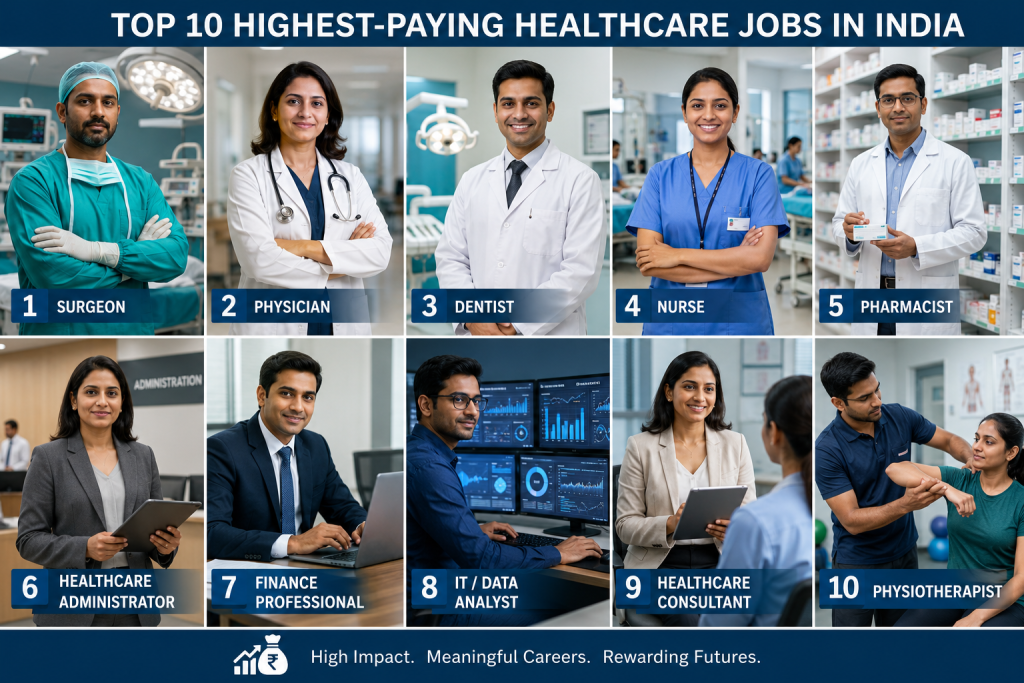
India’s healthcare sector is in the middle of a structural expansion that shows no signs of slowing. With a projected market size of over $370 billion by 2026, healthcare jobs salary in India has risen sharply across clinical, administrative, and technology functions. Whether you’re a medical professional, a management graduate, or a data analyst considering healthcare as a career path, the compensation landscape is genuinely strong — and diversifying fast.
The 2026 healthcare job market is no longer just about doctors and nurses. Healthcare management, healthcare finance, and healthcare IT are emerging as high-paying career tracks that attract professionals from outside clinical backgrounds. This guide covers all ten of the highest-paying roles with specific salary figures, employer names, and what drives compensation at each level.
For a broader view of how healthcare salaries compare to other industries, the average salary guide by sector on JobVumi provides a useful reference point for regional and national benchmarking.
Why Healthcare Jobs Are Highly Rewarding in India
Three forces are driving healthcare salary growth in India in 2026.
- Demand-supply gap: India has approximately 0.7 doctors per 1,000 people — far below the WHO-recommended ratio of 1:1,000. Skilled clinical professionals in short supply command premium pay, especially in Tier-2 cities where talent is even scarcer.
- Private sector investment: Hospital chains like Apollo Hospitals, Fortis Healthcare, Max Healthcare, Narayana Health, and Manipal Hospitals have collectively invested thousands of crores in capacity expansion. These companies compete aggressively for qualified talent at every level — clinical and non-clinical.
- Healthcare technology adoption: From telemedicine platforms to AI-assisted diagnostics, healthcare technology is creating entirely new job categories. Practo, Philips Healthcare India, and Siemens Healthineers India all recruit tech-trained professionals into healthcare-specific roles that didn’t exist a decade ago.
Top 10 Highest Paying Healthcare Jobs in India in 2026
1. Surgeon
Surgeons remain the highest-earning healthcare professionals in India. Specialisation is the primary compensation driver — cardiac, neurosurgery, oncology, and orthopaedic surgeons at premium private hospitals command the highest packages.
A senior cardiac surgeon at Apollo Hospitals, Fortis, or AIIMS-affiliated private practices earns ₹3,00,000–₹8,00,000 per month. General surgeons in mid-tier private hospitals earn ₹1,00,000–₹2,50,000 monthly. Consulting surgeon arrangements — where the professional operates across multiple hospitals — can generate even higher monthly income.
Qualification path: MBBS + MS (General Surgery) + Super-speciality (MCh) for subspecialties. Total training time: 12–14 years post-school.
2. Physician / Consultant Doctor
Specialist physicians — cardiologists, endocrinologists, neurologists, gastroenterologists, and pulmonologists — are consistently among the highest-compensated roles in Indian healthcare. The consulting model at large private hospitals means senior physicians receive a percentage of procedure and consultation billing, which can push monthly earnings to ₹2,00,000–₹5,00,000 at established practices.
At corporate hospital chains like Max Healthcare or Manipal Hospitals, senior consultants draw a combination of fixed retainer and variable component. Fresh MBBS MD graduates joining as junior consultants or registrars earn ₹80,000–₹1,50,000 monthly.
3. Dentist
Dentistry in India has undergone a significant value upgrade in the last decade. Senior dental surgeons at established clinics — particularly in metro cities — and specialists in orthodontics, implantology, and oral surgery earn ₹1,50,000–₹4,00,000 monthly. Clinic owners with their own practices and a strong patient base can earn considerably more.
Franchised dental chains like Clove Dental (operating 700+ clinics across India) and SmileLine hire dentists at ₹60,000–₹1,50,000 per month at various experience levels. The growing medical tourism sector has elevated dental surgery compensation further, as international patients seek quality treatment at Indian prices.
Qualification: BDS (5 years) + MDS for specialisation (3 years).
4. Pharmacist
The pharmacist role in India spans retail pharmacy, hospital pharmacy, pharmaceutical manufacturing, and clinical trials — each with distinct salary profiles. Clinical pharmacists at large hospital chains earn ₹30,000–₹65,000 monthly. Pharmaceutical industry roles at companies like Sun Pharma, Cipla, or Dr. Reddy’s Laboratories pay significantly more — a senior formulation pharmacist or regulatory affairs specialist earns ₹60,000–₹1,50,000.
Drug regulatory and medical affairs roles at MNC pharma companies (Pfizer India, AstraZeneca, Abbott Healthcare) are among the highest-paying pharmacist career paths, with total packages reaching ₹20L–₹35L annually for experienced professionals.
Qualification: D.Pharm / B.Pharm + M.Pharm for advanced roles.
5. Nursing Roles — Nurse Practitioner and Head Nurse
Nursing salaries in India have improved markedly as private healthcare has expanded, though regional disparities persist. A staff nurse at a Tier-1 private hospital in metro cities earns ₹20,000–₹35,000 monthly. Head nurses and nursing supervisors earn ₹40,000–₹70,000. Nurse practitioners specialising in critical care, oncology, or neonatal ICU earn a premium.
International nursing is a distinct high-earning pathway. Nurses with NCLEX-RN (USA) or CBT (UK NHS) certifications who migrate to the US, UK, or Middle East earn ₹2,00,000–₹5,00,000 monthly in destination countries — one of the most significant income multipliers in any Indian profession.
Domestically, AIIMS, Apollo, and Manipal group hospitals offer the highest nursing packages in the country.
Qualification: GNM (3 years) or B.Sc Nursing (4 years) + specialisation.
6. Healthcare Administrator
Healthcare administration jobs salary in India is rising as hospital chains professionalise their management functions. A healthcare administrator manages operations, staffing, compliance, and financial performance of a hospital or healthcare facility.
Junior hospital administrators (2–4 years experience) earn ₹25,000–₹50,000 monthly. Senior administrators and hospital managers at large chains earn ₹70,000–₹1,50,000. At the corporate level — operations directors, COOs of hospital chains — compensation reaches ₹2,00,000–₹4,00,000 monthly.
Apollo Hospitals, Fortis, and Aster DM Healthcare have structured management tracks that recruit MBA graduates from IIHMR, Symbiosis, and other healthcare management institutes into accelerated leadership programs.
Qualification: MBBS (not always required), MBA in Hospital Management / MHA from IIHMR Delhi, Symbiosis, or TISS.
7. Healthcare Finance Professional
Healthcare finance jobs salary is one of the lesser-discussed high-paying tracks in this sector. Healthcare organisations — hospital chains, pharma companies, health insurance firms — need finance professionals who understand both GAAP/Ind-AS accounting and healthcare-specific financial structures like insurance claim settlements, capitation models, and medical device procurement.
A finance manager with healthcare domain knowledge at a company like Star Health Insurance, HDFC ERGO Health, or Apollo Hospitals earns ₹80,000–₹1,60,000 monthly. Senior finance directors at large hospital chains or health insurance companies command ₹1,50,000–₹3,00,000.
The combination of CFA/CPA certification and healthcare industry experience is rare and commands a significant premium. For professionals considering this path, understanding the broader finance career landscape is useful — the salary negotiation guide on JobVumi covers how to benchmark and negotiate compensation in specialised roles.
Qualification: B.Com / MBA Finance + CFA or CPA + healthcare sector experience.
8. Healthcare IT and Data Analyst
Healthcare IT is the fastest-growing non-clinical career track in India’s healthcare sector in 2026. Roles include hospital information system (HIS) implementation specialists, healthcare data analysts, telemedicine platform developers, and health tech product managers.
Practo, 1mg (Tata Health), PharmEasy, Portea Medical, and Siemens Healthineers India are among the most active recruiters in this space. A healthcare data analyst with 3–5 years of experience earns ₹60,000–₹1,20,000 monthly. Health tech product managers at growth-stage companies earn ₹1,20,000–₹2,50,000.
For IT professionals considering healthcare as a target sector, this is arguably the most natural entry point — clinical knowledge is helpful but not required. Technical skills in Python, SQL, HL7/FHIR (healthcare data standards), and EMR systems like Epic or Oracle Health are the key differentiators.
Qualification: B.Tech / BCA + healthcare IT certifications (CPHIMS, HL7 Associate) + domain exposure.
9. Healthcare Consultant
Healthcare consulting jobs salary in India is high and underappreciated by most job seekers. Healthcare consultants work across hospital strategy, pharmaceutical advisory, public health policy, and health tech implementation. Employers include McKinsey & Company, Boston Consulting Group (BCG), EY, KPMG, Deloitte, and specialised healthcare consultancies like Frost & Sullivan Health and CareEdge (formerly ICRA Healthcare).
A junior healthcare consultant (post-MBA) earns ₹1,50,000–₹2,50,000 monthly at a top-tier firm. Senior managers and partners in healthcare consulting earn ₹3,00,000–₹8,00,000. The role typically requires a combination of domain expertise, quantitative analytical skills, and strong communication — making it competitive but extremely well-compensated.
Qualification: MBBS or MBA (IIM / XLRI / ISB preferred) + 2–5 years of healthcare industry experience.
10. Physiotherapist and Rehabilitation Specialist
Physiotherapy is one of the more undervalued high-earning healthcare careers in India. A senior physiotherapist with sports rehabilitation, neurological rehab, or paediatric specialisation earns ₹40,000–₹80,000 monthly at private hospitals and specialty clinics. Independent practitioners with their own clinic and a strong referral base can earn ₹1,00,000–₹2,50,000 monthly.
Rehabilitation specialists working with corporate wellness programs, sports clubs (IPL franchises and national sports federations retain in-house physios), and post-surgical recovery centres earn at the higher end. International demand — particularly in the UK, Australia, and UAE — also creates high-income migration pathways for qualified physiotherapists.
Qualification: B.PT (Bachelor of Physiotherapy, 4.5 years) + MPT for specialisation (2 years).
Salary Comparison Table for Top Healthcare Jobs in India 2026
| Role | Monthly Salary (INR) — Mid Level | Annual CTC (INR) |
| Surgeon (Specialist) | ₹1,50,000 – ₹5,00,000 | ₹18L – ₹60L+ |
| Consultant Doctor (Specialist) | ₹1,00,000 – ₹3,00,000 | ₹12L – ₹36L |
| Dentist (Experienced) | ₹60,000 – ₹1,50,000 | ₹7L – ₹18L |
| Pharmacist (Senior / Industry) | ₹60,000 – ₹1,50,000 | ₹7L – ₹18L |
| Head Nurse / Nurse Practitioner | ₹40,000 – ₹70,000 | ₹5L – ₹8.5L |
| Healthcare Administrator | ₹70,000 – ₹1,50,000 | ₹8L – ₹18L |
| Healthcare Finance Manager | ₹80,000 – ₹1,60,000 | ₹10L – ₹20L |
| Healthcare IT / Data Analyst | ₹60,000 – ₹1,20,000 | ₹7L – ₹14L |
| Healthcare Consultant (Senior) | ₹1,50,000 – ₹5,00,000 | ₹18L – ₹60L |
| Physiotherapist (Senior / Clinic Owner) | ₹40,000 – ₹1,00,000 | ₹5L – ₹12L |
Key Factors Influencing Healthcare Salaries in India
Understanding what drives pay disparity within healthcare careers helps professionals negotiate from an informed position.
- Specialisation: Across every healthcare role, sub-specialisation is the single biggest salary lever. A general physician earns a fraction of a cardiologist. A general pharmacist earns less than a regulatory affairs specialist at an MNC pharma firm. Invest in a recognised subspecialty.
- Sector and employer type: Government healthcare (AIIMS, state government hospitals) pays fixed-scale salaries that are typically lower in absolute terms but come with job security and retirement benefits. Corporate hospital chains pay significantly more but are performance-oriented. Pharma and health insurance companies often offer the best total compensation packages including bonuses and ESOPs.
- City and geography: Metro cities — Mumbai, Delhi, Bangalore, Hyderabad, Chennai — consistently pay 20–40% more for equivalent roles than Tier-2 cities. However, healthcare professionals in smaller cities can earn relatively more in their local market context, particularly when running independent practices.
- Certifications and credentials: International certifications (USMLE for doctors, NCLEX for nurses, CPHIMS for healthcare IT, CFA for healthcare finance) consistently command a premium — both for domestic roles at MNC employers and for international career pathways.
- Research and academic output: Doctors with published research, clinical trial experience, or academic positions at medical colleges earn recognition premiums, particularly in institutional and corporate hospital settings.
Tips to Maximize Your Healthcare Salary in India
These strategies work specifically within the Indian healthcare compensation context:
- Sub-specialise early. The salary gap between a generalist and a sub-specialist compounds over time. A fellowship in a high-demand subspeciality (cardiac surgery, neurology, oncology) is worth 3–5 years of general practice income growth.
- Target corporate hospital chains over standalone hospitals. Apollo, Fortis, Max, and Narayana Health have structured pay bands, annual increments, and benefit programs that standalone institutions typically don’t.
- Negotiate variable components. Many healthcare roles have room for negotiating call allowances, consulting fees, performance bonuses, and ESOP structures that base salary comparisons miss entirely.
- Build an international option. For nurses, physiotherapists, and allied health professionals, eligibility for international practice (NCLEX, IELTS/OET, licensing exams) dramatically increases negotiating leverage even if you don’t ultimately migrate.
- Cross into healthcare management or consulting. Clinicians who add an MBA or healthcare management degree from IIHMR or TISS open compensation bands that are structurally higher than clinical practice alone.
Best Cities for High-Paying Healthcare Jobs in India
Not all cities offer equal healthcare salary potential. Here’s where the highest-paying roles concentrate:
- Mumbai: India’s largest private healthcare market, with JJ Hospital, Lilavati, Kokilaben Dhirubhai Ambani Hospital, and a dense network of corporate chains. Pharma company headquarters — Sun Pharma, Cipla — also create high-paying non-clinical healthcare roles here.
- Delhi / NCR: AIIMS, Max Healthcare, Fortis, and Sir Ganga Ram Hospital anchor the market. Delhi’s medical tourism concentration drives premium surgical compensation. Healthcare consulting roles at McKinsey and BCG are primarily Delhi-based.
- Bangalore: Strong healthcare IT sector. Narayana Health headquarters, Manipal Hospitals corporate office, and health tech startups like Practo, Portea, and 1mg create strong demand for both clinical and technology-adjacent healthcare professionals.
- Chennai: Apollo’s headquarters, MIOT International, and a strong medical college ecosystem. One of India’s top medical tourism destinations, which elevates clinical salaries.
- Hyderabad: Emerging healthcare hub with strong pharma (Dr. Reddy’s, NATCO Pharma) and growing hospital chains. Apollo, Yashoda Hospitals, and KIMS Hospitals are major employers.
Career Growth Opportunities in Healthcare
Healthcare careers in India in 2026 offer growth pathways that extend well beyond the clinical track.
Clinical professionals can move into healthcare consulting (with or without an additional degree), clinical research (CRO firms like IQVIA and Syneos Health actively recruit in India), medical affairs at pharma companies, or health policy at NGOs and government advisory bodies.
Non-clinical healthcare careers — administration, finance, IT, and consulting — offer growth trajectories comparable to equivalent roles in other industries, with the added advantage of a sector that structurally cannot offshore most of its workforce.
For those comparing healthcare management compensation against other management career paths, the marketing manager salary guide on JobVumi provides a useful cross-industry reference.
The emergence of digital health — telemedicine, AI diagnostics, remote patient monitoring, and health data platforms — is creating product management, data science, and business development roles that didn’t exist five years ago. These hybrid roles often carry compensation structures aligned with tech industry norms rather than traditional healthcare pay bands.
Final Thoughts and Career Action
Healthcare jobs salary in India in 2026 reflects a sector under genuine transformation. Clinical roles at the top of the specialisation pyramid remain among the highest-paying professions in the country. But the real story in 2026 is how healthcare management, healthcare finance, and healthcare IT have become high-compensation career tracks in their own right — accessible to professionals from business, technology, and data backgrounds.
The common thread across all ten roles in this guide is specificity. Sub-specialisation, targeted certifications, and strategic employer choices matter far more than generic experience accumulation.
JobVumi tracks verified healthcare job openings across India — from hospital administrator and healthcare finance roles to clinical positions and health tech opportunities. Browse healthcare and medical services jobs on JobVumi and find openings that match your qualification, experience level, and salary expectations.
Frequently Asked Questions
1. What are the highest-paying healthcare jobs in India?
The highest-paying healthcare jobs in India in 2026 are specialist surgeons (cardiac, neuro, oncology), consultant physicians, healthcare consultants at top firms like McKinsey and BCG, healthcare finance managers at hospital chains and health insurers, and healthcare IT professionals at health tech companies like Practo and Siemens Healthineers India.
2. Which city offers the best healthcare salary in India?
Mumbai, Delhi/NCR, and Bangalore offer the highest healthcare salaries in India. Mumbai leads for pharma and clinical roles; Delhi for hospital consulting and surgical specialties; Bangalore for healthcare IT and health tech. Chennai is the top city for medical tourism-driven surgical compensation, with Apollo and MIOT International as anchor employers.
3. How much can healthcare administrators earn in India?
Healthcare administration jobs salary in India ranges from ₹25,000–₹50,000/month at the junior level to ₹70,000–₹1,50,000 for senior hospital managers. COOs and operations directors at large hospital chains like Apollo or Fortis earn ₹2,00,000–₹4,00,000 monthly. MBA graduates from IIHMR or TISS enter structured programs with accelerated salary growth.
4. Do nurses earn well in India?
Domestically, staff nurse salaries range from ₹20,000–₹35,000/month at private metro hospitals. Head nurses earn ₹40,000–₹70,000. The highest earnings come via international migration — NCLEX-qualified nurses working in the US or UK earn ₹2,00,000–₹5,00,000 monthly. International certification significantly changes the earning ceiling for Indian nurses.
5. What skills increase healthcare salaries?
Clinical sub-specialisation, international practice certifications (NCLEX, USMLE, CPHIMS), healthcare IT knowledge (HL7/FHIR, EMR systems), MBA in hospital management, and pharma regulatory affairs expertise all command clear salary premiums. For non-clinical roles, combining healthcare domain knowledge with financial analysis, data analytics, or consulting skills creates the highest compensation opportunities.
6. Are healthcare consultant roles lucrative in India?
Yes. Healthcare consulting jobs salary is among the highest in the sector. Senior consultants at McKinsey, BCG, EY, and KPMG earn ₹3,00,000–₹8,00,000/month. Entry-level post-MBA consultants at top firms earn ₹1,50,000–₹2,50,000. The role requires healthcare domain knowledge plus strong analytical and communication skills — making it competitive but extremely well-compensated.
