Indian professionals cannot be seen by recruiters who use LinkedIn: not because they are unqualified, but because they are part of the “opt-in” group of the search engine that will keep pushing them down. If recruiters do not contact you when looking for work on LinkedIn in India, you can fix it – beginning with understanding how recruiters find their candidates there.
Here is a step-by-step guide on how you can set up a LinkedIn profile in 2026 that will attract recruiter direct messages from India, along with how you should correct your headline, About section, experience, and open-to-work status that most Indian professionals set up incorrectly. If you wish to gain exposure outside LinkedIn, submit your CV through JobVumi so that recruiters can find you on the largest job portal in India.
Why Most Indian Job Seekers Never Get Recruiter DMs
However, this is not because of your experience, but rather your visibility.
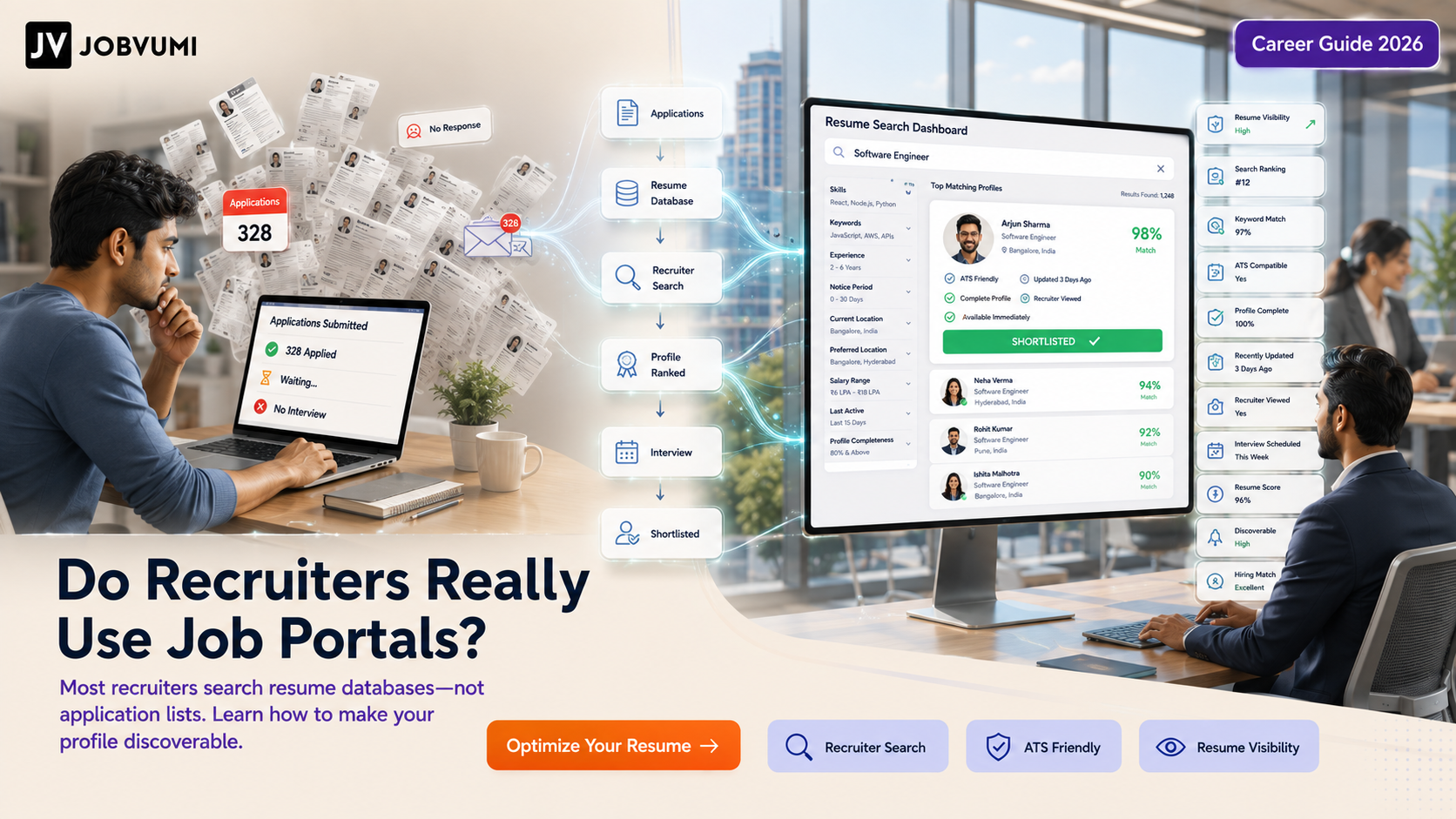
Recruiters in India make use of LinkedIn Recruiter, which is a paid version of LinkedIn that filters out potential candidates based on certain criteria such as keyword, geographical location, designation, skill set, and “Open to Work.” If you haven’t filled out these parameters in your profile, then recruiters won’t see your profile at all.
The top 5 reasons why Indian candidates never get recruiter messages
- Keywords are missing from your headline. Recruiters use skill sets and role titles to find candidates. “Graduate of IIT Bombay | Passionate about Technology” will never be found by recruiters. But “Full Stack Developer | React | Node.js | Open to Work” will.
- “Open to Work” status is public, not private. While many freshers and professionals make their banner visible to everyone, there’s another option which indicates that you’re open to working, but only for recruiters, and no current employer sees it.
- Skills section is blank or generic. LinkedIn’s algorithm matches you according to your skills. No skills or irrelevant ones mean that you won’t appear in recruiter searches.
- Profile picture or low-quality image present. A professional picture will get you 21 times more profile visits and 36 times more messages (data by LinkedIn). Recruiters in India unanimously agreed that having a profile photo was the minimum requirement.
- Location entered incorrectly or not entered. Recruiters will look at their city preferences only. By entering “India” instead of “Bangalore” or “Mumbai,” you would have automatically filtered out from city-based recruitment processes which prevail in India.
LinkedIn Profile Sections That Get You Recruiter DMs in India
The sections below each play a role in the LinkedIn search and display algorithm. You should treat them as individual conversion elements, not as your digital resume, which you fill out and then ignore.
The Headline — Your Most Important 220 Characters
Your headline is the first thing a recruiter sees in search results — before they click your profile. Most Indians misuse it by putting in their job role or some other ambiguous term.
The winning combination is: [Job Role] | [Skill 1] | [Skill 2] | [Skill 3] | [Title/Speciality]
Sample headlines that make recruiters message you:
- Java Backend Developer | Spring Boot | Microservices | AWS | Available for Full-Time positions in Bangalore
- Digital Marketing Executive | SEO | Google Ads | Meta Ads | 3+ Years Exp | Available for Work
- Data Analyst | Python | SQL | Power BI | Fresh Graduate | B.Tech, NIT Trichy
Observe how all of these headlines have keywords that recruiters from TCS, Infosys, Wipro, Accenture, and other mid-size product companies enter in LinkedIn Recruiter.
The About Section — Where You Convert Views Into Messages
An “About” section is not a resume summary. It is a short narrative that explains why you should be contacted within five seconds.
What it must include:
- What you do and what you excel at (1-2 sentences)
- The abilities and techniques you employ when working with natural languages (not a bulleted list — that goes in the Skills section)
- What type of position you are searching for and where
- An immediate call to action: “Looking for openings in Bangalore / remotely. Please reach out!”
What not to do: Write in the third person, use ambiguous words like “team player,” or begin with “I am a dedicated individual.”
A strong About section for a fresher might read: “B.Tech Computer Science graduate from VIT Vellore with hands-on experience in Python and data analysis through internships at Wipro and a personal ML project with 5,000+ GitHub stars. Looking for data analyst roles in Hyderabad or remote. Open to connect — feel free to message.”
Experience Section — Use Role-Based Keywords, Not Job Descriptions
Recruiters search for keywords, tools used, and accomplishments from the experience section — not responsibilities. Each point must start with an action verb and have quantifiable results.
Poor: “Responsibilities include updating and managing the company’s social media profiles.” Good: “Increased Instagram followers from 2,000 to 18,000 within 6 months with a content plan and posting calendar.”
For fresher candidates, mention your internship, academic project, participation in hackathon, and freelance projects under the Experience section. A ₹500 Google Ads campaign you ran for a local business with documented results is legitimate experience. Put it in.
Skills Section — The Section That Drives Search Ranking
LinkedIn allows up to 50 skills. Add all of them that are relevant. Don’t hold back.
For a software developer in India, skills like Java, Python, React, Node.js, AWS, SQL, Git, Agile, and REST APIs all need to be listed individually — recruiters at Infosys BPM, Accenture, Capgemini, and product companies search these as separate filters. Missing even one commonly searched skill removes you from filtered searches where that skill is required.
Get endorsements on your best skills. Ask your classmate, co-workers, or managers for an endorsement. LinkedIn considers endorsed skills more important than non-endorsed skills in search results.
LinkedIn Profile Checklist for Indian Job Seekers 2026
Use this as a practical audit of your current profile:
Visibility Basics
- Profile photo present: professional, clear, good lighting
- Location set to specific city (not just “India”)
- “Open to Work” set to “Recruiters Only” (not public green banner — unless you want your current employer to see it)
- Custom LinkedIn URL: linkedin.com/in/yourname (not the randomly generated one)
Headline Optimisation
- Contains your target role title
- Includes 2–3 specific skills or tools
- Mentions open-to-work status or differentiator
- No vague phrases like “passionate” or “enthusiastic”
About Section
- Written in first person
- Mentions what you do + what you’re looking for + location
- Ends with a call to action
- Between 150-300 words (Long enough to provide depth, but short enough to read)
Experience
- Every role / internship listed with outcomes, not just duties
- Tools and technologies mentioned by name
- Project links, GitHub, or portfolio URLs added where possible
Education and Certifications
- Name of degree with year of graduation
- These are some certifications that have been included: Google Ads, Meta Blueprint, AWS, HubSpot, NISM
- Any relevant course on Coursera/NPTEL is listed
Skills
- At least 20–30 relevant skills listed
- Top 3 skills endorsed by connections
- Skills match keywords in your target job descriptions
Activity
- At least 2–3 posts or reposts visible on your feed (zero activity looks like an abandoned account)
- Connected with at least 200+ people (threshold where LinkedIn’s “2nd degree” network effects kick in)
One Thing to Do Today That Guarantees More Recruiter Views
If you do nothing else from this guide today, do this: rewrite your LinkedIn headline using the formula above and turn on “Open to Work” for recruiters only.
These two changes take under 10 minutes and have the most direct, immediate impact on recruiter discoverability. Recruiters running searches in LinkedIn Recruiter for your role title will start seeing your profile in results — often within 24–48 hours of the change.
Next, for each job you apply to through any job portal, do a manual search for the recruiter/hiring manager on LinkedIn and connect with him/her via a personalized message. The strategy of connecting directly post-application has a proven track record of yielding higher callbacks especially at mid-sized Indian companies wherein a single recruiter handles the entire recruitment process.
Browse open jobs in India on JobVumi — find roles that match your profile, apply directly, and then use LinkedIn to connect with the company’s recruiters immediately after. The combination of a verified job application and a LinkedIn connection request is one of the most effective dual-channel strategies in India’s 2026 job market.
Your LinkedIn Profile Is a Search Ad — Start Treating It Like One
Here’s the reframe that shifts how Indian job seekers use LinkedIn – Your profile is not a CV; it’s a search ad for your skills, with recruiters searching for what you bring to the table.
Good search ads have keywords and a well-defined call to action. Poor search ads don’t result in conversions. Similarly, every section of your profile – the headline, About, Experience, and Skills – should be optimised to attract recruiters.
The Indian professionals who always receive DMs from recruiters are not necessarily those with the most experience or qualifications. Rather, they are those who have their profiles optimised based on how recruiters search.Fix your profile with the steps in this guide. Then make sure you’re visible on multiple channels — post your resume on JobVumi alongside your updated LinkedIn profile, and let verified recruiters across India find you where they’re actively looking.