
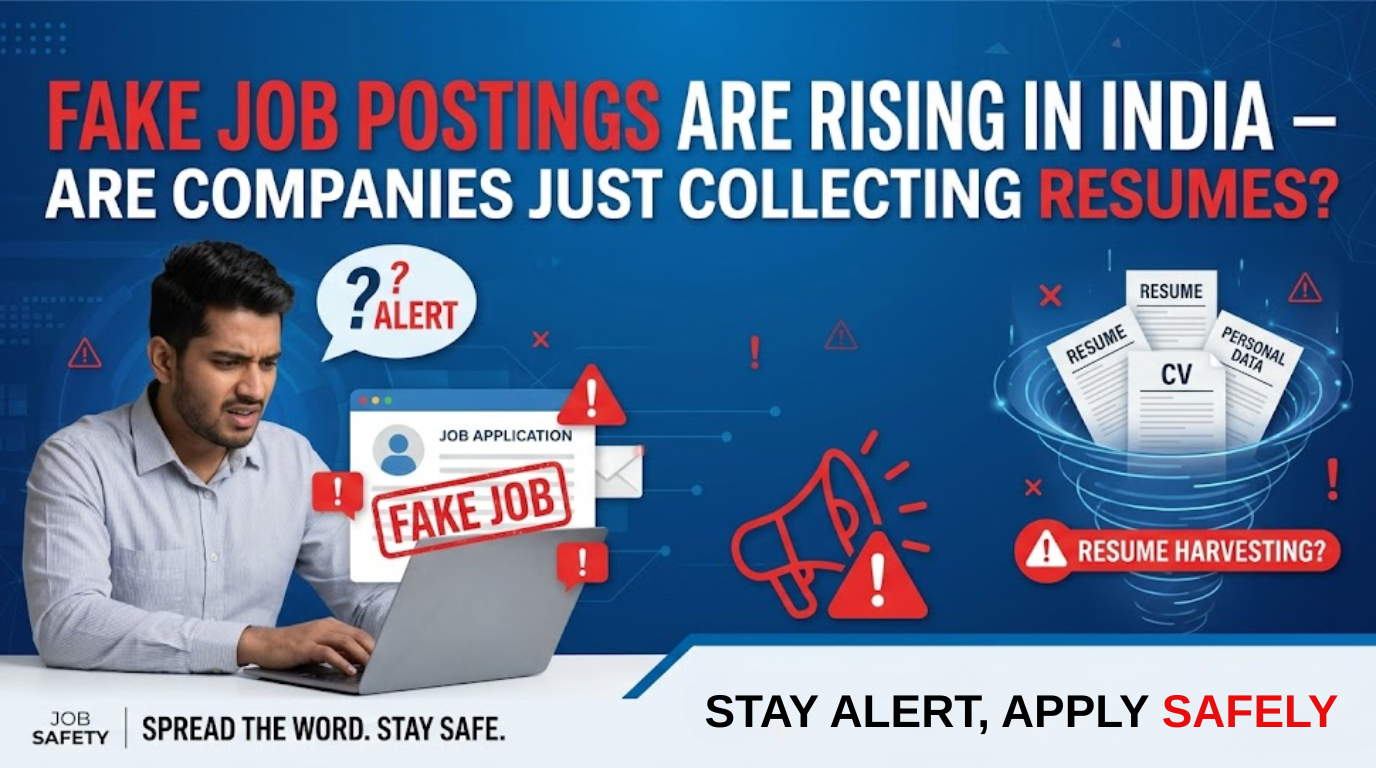
Have you ever applied to dozens of jobs online and never heard back from even one?
If yes, you are not alone.
Across India, many job seekers now believe fake job postings are becoming more common on job portals. Some listings remain active for months without updates. Others collect resumes but never respond. Over time, this creates confusion and reduces confidence in the online hiring process.
Recent hiring trend discussions suggest that a significant number of candidates suspect fake job advertisements while applying online. At the same time, cybercrime reports continue to show steady growth in job scams in India over the past few years.
Naturally, a question comes up:
Are companies posting jobs just to collect resumes?
Or are these listings part of something else happening behind the scenes?
The truth is more complex than it appears.
This article explains:
- what fake job postings actually are
- why companies sometimes post jobs without immediate hiring
- how recruitment scams operate
- how to identify suspicious listings
- and how job seekers can protect themselves while applying online
What are fake job postings?
Not every suspicious job listing is a scam.
Understanding this difference helps job seekers avoid unnecessary confusion.
Not all fake job posts are scams
There are three main types of listings often described as fake:
1. Completely fake job advertisements (fraud intent)
These are created by scammers to collect money or personal information.
2. Ghost job postings (no immediate hiring plan)
Companies publish these even when hiring is paused.
3. Resume pipeline listings (future hiring preparation)
Employers collect resumes for future openings.
From a job seeker’s perspective, all three look similar:
- no response
- repeated reposting
- unclear timelines
That is why frustration increases.
Today, fake job postings in India are increasing across both scam and non-scam categories, making it harder to separate genuine opportunities from inactive listings.
Why companies post fake job openings even when they are not hiring
Many candidates ask a direct question:
Are companies collecting resumes without hiring?
Sometimes the answer is yes.
But the reason is not always dishonest.
Talent pipeline building
Large organisations often prepare in advance for future hiring needs.
They collect resumes to:
- reduce hiring delays later
- maintain candidate databases
- identify emerging skill availability
- respond faster during expansion
This helps HR teams move quickly when positions open.
Market testing salaries and skills demand
Companies also use listings to understand the labour market.
They analyse:
- expected salary ranges
- available candidate experience levels
- city-wise skill availability
- competition for specialised talent
These insights help companies plan realistic hiring budgets.
Employer branding visibility
Some organisations post roles to remain visible in the hiring ecosystem.
They want to:
- appear active and growing
- attract passive candidates
- maintain employer presence on job portals
This practice can feel misleading for applicants, but it is not always intended to deceive.
The rise of real job scams in India
While ghost postings create confusion, job frauds in India are a different issue entirely.
These involve intentional deception.
Why recruitment scams are increasing
Several factors are contributing to the rise of online job scams India:
- rapid expansion of digital hiring platforms
- growth of remote job opportunities
- increase in fake work from home jobs
- misuse of digital payment channels
- identity theft risks through resume sharing
Cybercrime agencies have reported steady growth in complaints related to fake job offers and hiring fraud in recent years.
This makes awareness more important than ever.
Common types of fake job postings in India today
Understanding the patterns behind fake hiring posts helps candidates avoid risk.
Fake work from home jobs
This is currently the most reported category of fraud.
Typical warning signs include:
- unrealistic salary promises
- immediate selection without interview
- payment requests before joining
- unclear role responsibilities
Today, fake work from home jobs are the most reported category in job frauds in India.
Fake HR calling scams
These scams usually follow a predictable pattern.
For example:
- unexpected recruiter phone call
- urgent hiring claim
- guaranteed selection promise
- processing fee request
Legitimate employers never charge candidates application fees.
Impersonation of well-known companies
Fraudsters often pretend to represent recognised brands.
They typically:
- copy company logos
- clone job descriptions
- create fake email domains
- send unofficial interview links
Because the brand looks familiar, candidates trust the listing.
Resume harvesting scams
Some fake job post listings exist only to collect personal information.
Fraudsters target:
- phone numbers
- email addresses
- Aadhaar or identity documents
- employment history details
These details may later be misused for fraud.
Signs of fake job postings online every job seeker should know
Knowing the warning signals can protect you from most scams.
Warning signs to watch carefully
Look closely if you notice:
- recruiter asks for money
- unclear job description
- generic email ID instead of company domain
- missing company website
- unrealistic salary for freshers
- immediate selection without interview
- repeated reposting for months
These are common signs of fake job postings online across many platforms.
Verification is always worth the effort.
Myth vs reality about fake job postings
Many misunderstandings exist around fake job advertisements.
Let’s clarify some of them.
Myth 1: Every non-response means the job was fake
Reality:
Sometimes resumes are filtered by ATS recruitment software before recruiters review them.
High application volume also reduces response rates.
Myth 2: Only small companies post fake job advertisements
Reality:
Fraudsters often impersonate large companies because candidates trust them more.
Myth 3: All job portals allow scams
Reality:
Most platforms actively try to remove suspicious listings.
However, filtering millions of postings is challenging.
Myth 4: Government jobs never have fake listings
Reality:
Fake government job offers are among the most common scam formats.
Always verify through official sources.
How to identify fake job postings in India step by step
Learning how to identify fake job postings in India can significantly improve your job search safety.
Follow these steps carefully.
Step 1: Verify the company website
Check:
- Official careers page availability
- Company contact details
- Domain-based email IDs
Legitimate organisations maintain structured career pages.
Step 2: Search recruiter profile online
Look for:
- LinkedIn presence
- Employee directory listing
- Company verification signals
Fake recruiters rarely maintain consistent online identities.
Step 3: Never pay application fees
This is one of the strongest warning signals.
Real employers do not charge candidates.
Step 4: Check posting history on job portals
Repeated reposting without updates can indicate inactive hiring intent.
Step 5: Cross-check job description authenticity
Search whether identical descriptions appear across multiple suspicious listings.
Learning how to avoid fake job scams in India starts with simple verification habits like these.
Why job seekers feel trust issues with traditional job portals
Many candidates share similar experiences across multiple platforms.
Common concerns include:
- repeated applications without responses
- duplicate job listings
- outdated openings still active
- unclear employer hiring intent
- uncertainty about resume visibility
Have you applied to the same job more than once without knowing it?
This happens more often than most job seekers realise.
As a result, expectations from job platforms are changing.
Candidates now want clarity before investing effort in applications.
What a trustworthy job platform should do differently
Modern job seekers expect hiring transparency.
A reliable job platform should provide:
- verified job listings
- real employer hiring signals
- transparent posting timelines
- fewer duplicate opportunities
- safer application workflows
These features help reduce uncertainty during job search.
They also improve candidate confidence.
Quick checklist to stay safe from fake job offers
Use this checklist before applying anywhere.
Before applying
- verify recruiter email domain
- check company website authenticity
- search job title across platforms
Before interview
- confirm official communication channel
- avoid sharing unnecessary identity documents early
Before accepting offer
- confirm HR contact authenticity
- never transfer money
- verify offer letter format
Following this checklist helps avoid recruitment scams and job portal scams effectively.
How platforms like JobVumi help reduce fake job postings risk
Job seekers today want structured, trustworthy opportunities.
Platforms designed with transparency in mind help reduce confusion during applications.
JobVumi focuses on:
- curated listing visibility
- clearer employer intent signals
- reduced duplicate postings
- simplified job discovery experience
- structured city-wise job navigation
Candidates searching opportunities such as:
- jobs in Delhi
- jobs in Mumbai
- jobs in Bangalore
- jobs in Hyderabad
- jobs in Pune
- jobs in Bhubaneswar
- jobs in Chandigarh
benefit from organised location-based listings that make applications more focused and efficient.
Instead of applying randomly across hundreds of uncertain listings, candidates can apply more strategically.
Are job portal listings trustworthy today?
Most job portals are designed to support real hiring activity.
However:
- high listing volume
- employer automation tools
- duplicate postings
- pipeline hiring strategies
can create confusion for applicants.
That is why job seekers should always combine platform usage with personal verification checks.
Why companies post fake job openings: the complete reality
So why do organisations sometimes post jobs without immediate hiring?
Common reasons include:
- future hiring preparation
- talent database building
- salary benchmarking
- competitor monitoring
- employer branding visibility
Understanding this helps job seekers interpret listings more realistically.
Not every inactive job posting is dishonest.
But awareness is essential.
Common job scams in India and how to avoid them
Candidates should stay alert to the most common fraud formats.
Examples include:
- fake airport job offers
- fake government job recruitment messages
- fake overseas placement promises
- fake HR WhatsApp interviews
- fake training-fee-based selection claims
Learning common job scams in India and how to avoid them helps candidates stay safe during job search.
Verification always reduces risk.
Conclusion: fake job postings are rising, but awareness protects you
Yes, fake job postings in India exist.
Yes, some companies collect resumes without immediate hiring.
And yes, online job scams in India continue affecting many candidates every year.
But there is also good news.
Most risks can be reduced through simple steps:
- verify recruiters carefully
- check company authenticity
- avoid payment requests
- apply strategically
- use structured job discovery platforms
Job seekers deserve clarity and genuine opportunities.
If you want job listings with clearer intent and fewer distractions, start your search with trusted platforms that focus on real hiring updates and organised opportunities across Indian cities.
