
Recruiters today deal with a huge number of job applications. For popular roles, companies may receive hundreds or even thousands of resumes within a few days. Manually reviewing each application can take a lot of time and effort. This challenge is one of the main reasons why companies use automated recruitment tools.
This is where resume parsing becomes important. Resume parsing technology helps recruiters quickly extract useful information from resumes and convert it into structured candidate data.
If you are wondering what resume parsing is, it is a system used by recruitment platforms to automatically read and organize resume information such as skills, education, and experience.
In modern hiring, the resume parsing meaning in recruitment goes beyond simple data extraction. Many platforms now use AI-based resume parsing to speed up candidate screening and improve hiring decisions.
What is Resume Parsing?
To understand what resume parsing is, it helps to think of it as a digital assistant for recruiters.
A resume parser is software that reads resumes and automatically extracts key details. Instead of recruiters entering candidate information manually, the system converts resume content into structured data.
In simple terms, the resume parsing meaning in recruitment is the process of transforming an unstructured resume document into organized candidate information that can be searched and filtered easily.
A resume parser usually extracts information such as:
- candidate name and contact details
- work experience
- education qualifications
- skills and technical abilities
- certifications and training programs
For example, if a candidate uploads a resume in PDF or DOCX format, the system scans the document and identifies key sections like education or work history.
This data is then stored in a recruitment database, allowing HR teams to search candidates by skills, job titles, or qualifications. As a result, resume parsing helps recruiters manage large candidate databases more efficiently.
Do you know Why Resume parsing is the most important feature of ATS? Know about the ATS-based resume in 2026.
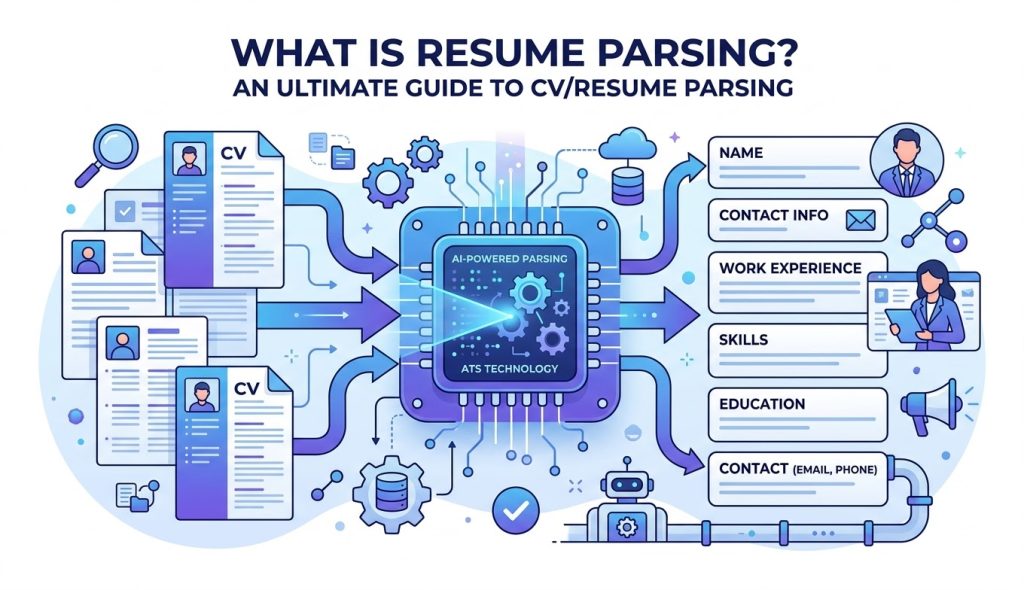
How resume parsing works in recruitment
Understanding how resume parsing works in recruitment helps explain why it is widely used in modern hiring systems.
Most recruitment platforms follow a structured process when parsing resumes.
Step 1: Candidate uploads the resume
The process begins when a candidate uploads a resume through a job portal or recruitment platform.
Step 2: Resume format detection
The system identifies the document format, such as PDF, DOCX, or text files.
Step 3: Text extraction
The resume parser scans the document and extracts readable text from the resume.
Step 4: Keyword and data recognition
Using CV parsing technology, the system identifies sections like skills, education, job titles, and company names.
Step 5: Data structuring
The extracted information is organized into structured fields such as:
- Candidate Name
- Work Experience
- Skills
- Education
Step 6: Storage in recruitment database
Finally, the structured candidate profile is stored in the Applicant Tracking System (ATS) database.
For example, a recruiter searching for “digital marketing skills” can quickly find candidates whose resumes contain those keywords.
Because of this structured approach, CV parsing technology enables recruiters to quickly filter applications and focus on the most relevant candidates.
Role of AI in resume parsing
Modern resume parsing systems are becoming smarter thanks to artificial intelligence. AI resume parsing improves the accuracy and efficiency of candidate data extraction.
Traditional resume parsers relied mainly on simple keyword matching. Today, AI-based systems use advanced technologies such as:
- Natural Language Processing (NLP)
- Machine Learning
- Pattern recognition
These technologies help the system understand the context of information in resumes.
For example, AI can recognize that “software developer,” “software engineer,” and “programmer” are related job roles. This improves candidate matching during recruitment.
Another advantage of ai resume parsing is skill detection. AI can identify both technical and soft skills even if they are described in different ways.
For recruiters, this means:
- faster candidate screening
- improved talent matching
- reduced manual resume review
As recruitment becomes more data-driven, how AI resume parsing improves hiring is becoming increasingly important. AI helps HR teams identify suitable candidates quickly while maintaining accuracy in candidate data.
Benefits of resume parsing for recruiters
The benefits of resume parsing for recruiters are significant, especially for companies handling large volumes of job applications.
Without resume parsing, recruiters would need to manually review resumes and enter candidate information into databases. This process is time-consuming and prone to human errors.
Using resume parsing software helps simplify recruitment tasks and improve efficiency.
Key benefits include:
- Faster candidate screening: Resume parsing tools allow recruiters to scan hundreds of resumes within seconds.
- Reduced manual data entry: Instead of typing candidate details manually, the system automatically extracts and organizes resume information.
- Better candidate search: Recruiters can search candidates by skills, qualifications, or experience.
- Improved hiring efficiency: By quickly identifying suitable candidates, HR teams can speed up the hiring process.
- Organized candidate database: All candidate profiles are stored in structured formats, making recruitment data easier to manage.
Because of these advantages, many companies now rely on resume parsing tools for HR teams as part of their recruitment technology stack.
Resume parsing tools for HR teams
Several companies provide resume parsing software that helps recruiters manage large numbers of applications.
These tools are designed to read resumes in different formats and convert them into structured candidate profiles.
Some commonly used resume parsing tools include:
- Oorwin
- Ceipal
- JobsHR
- TrackTalents
These tools support multiple resume formats and integrate easily with Applicant Tracking Systems.
Key features of modern resume parsing tools for HR teams include:
- support for PDF, DOCX, and multiple resume formats
- AI-based skill detection
- automated data extraction
- integration with ATS platforms
- candidate profile creation
Using a reliable resume parser helps recruiters focus more on evaluating candidates rather than manually processing resumes.
Conclusion
Modern recruitment processes require speed, accuracy, and efficient data management. This is why resume parsing has become an important part of hiring technology.
By automatically extracting candidate information from resumes, a resume parser helps recruiters organize and search large candidate databases quickly.
With the rise of AI resume parsing, recruitment platforms can now analyze resumes more accurately, identify relevant skills, and improve candidate matching.
For HR teams and recruitment platforms, resume parsing tools simplify hiring and reduce manual work.
As recruitment continues to evolve, automated technologies like resume parsing will play an even bigger role in modern hiring systems.If you want to explore smarter recruitment solutions and connect with candidates efficiently, register on Jobvumi and experience modern hiring tools designed for faster recruitment.
